Why a single source matters
Every support team has an unwritten knowledge base: the answers live in the heads of the two people who have been there longest. It works until one of them is on holiday, or a new agent joins, or two agents give a customer different versions of the return policy in the same week.
Writing it down is not the hard part. Keeping one version of it is. The failure mode is not an empty knowledge base — it is three of them: a document for onboarding, a set of snippets in someone's notes, and whatever the AI was configured with six months ago.
In wavadesk there is one store, and it feeds three consumers: the AI agent, which answers from it; saved replies, which your agents insert; and eventually self-serve content, so customers can find answers without messaging at all. Update the source and all three change.
The agent answers only from this material, in your wording, and escalates when it is not covered.
Agents insert the canonical answer instead of retyping an approximation.
When someone needs the exact policy wording mid-conversation, it is one search away.
One version, with a history of what changed and when — which matters when a policy is disputed.
How to structure it
The instinct is to write long articles. Resist it. The AI matches on questions, and agents insert answers — both work better with short, single-topic entries than with a comprehensive policy document.
One question, one entry
An entry should answer exactly one thing. "What are your delivery times" and "Do you deliver on Sundays" are two entries even though both are about delivery, because a customer asks them separately and the answers differ.
Write the answer as you would send it
The AI uses your text as the basis for its reply, so the tone of your knowledge base becomes the tone of your automated support. Write entries as messages to a customer, not as internal documentation.
| Do | Do not |
|---|---|
| "Standard delivery is 3 to 5 business days. Express arrives within 24 hours." | "DELIVERY POLICY: Refer to logistics SLA section 4.2." |
| One entry per question | One entry covering all shipping topics |
| Plain language a customer reads | Internal jargon and system names |
| State the exception in the same entry | Leave the edge case for the agent to remember |
Cover the exceptions explicitly
Most escalations are not unusual questions, they are the exception to a common question. If Sunday delivery is unavailable except in two cities, write that in the entry. An entry that is right 90% of the time trains your team to distrust the whole base.
How the AI uses it
When a message arrives, the agent matches it against your entries and drafts a reply grounded in the ones that fit. It is not answering from general world knowledge, which is why it cannot invent a refund window you do not offer.
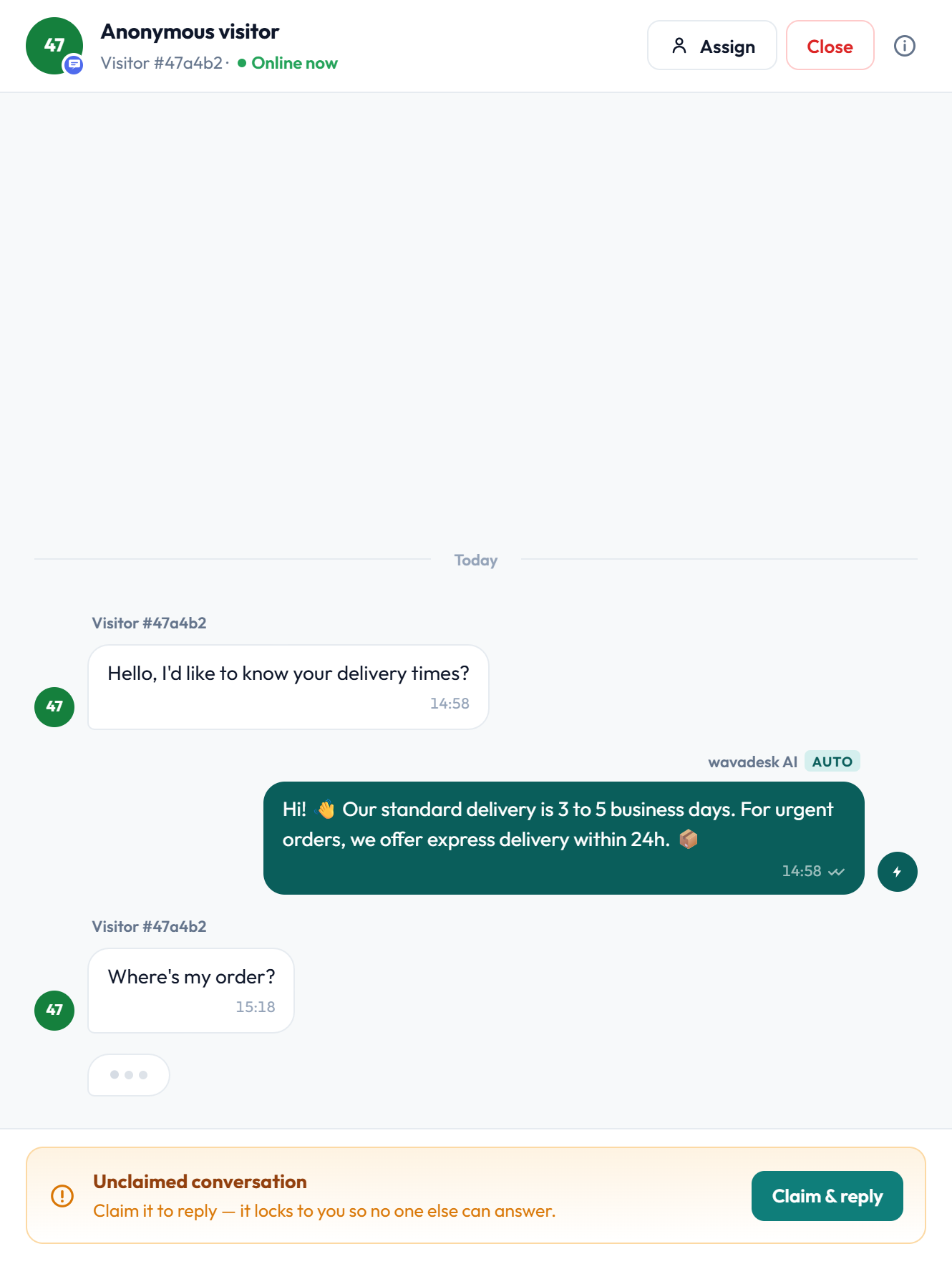
When nothing matches confidently, the agent escalates rather than improvising. That makes your knowledge base the direct lever on automation rate: every gap you close converts a category of escalation into an automated answer.
Run the AI in suggest mode for a week and read what it drafts. Where the drafts are weak, your knowledge base is thin — this is far cheaper than discovering it through a customer.

Saved replies for agents
Even with AI handling the common path, agents type a lot of near-identical messages: asking for an order number, explaining a returns process, confirming an address change. Saved replies make those one insertion instead of one composition.
- Insert a canonical answer into the composer with a keyboard shortcut
- Edit before sending, because the surrounding conversation always needs a sentence of its own
- Placeholders for customer name and order reference, filled from the conversation
- Organised by team, so billing snippets do not clutter the sales queue
- Same source as the AI, so an agent and the bot never contradict each other
The discipline that matters: when an agent finds themselves editing the same saved reply the same way repeatedly, that edit belongs in the source. Otherwise you have re-created the scattered-knowledge problem inside the tool.
Keeping it current
A knowledge base decays. Prices change, policies change, a product is discontinued and the entry describing it quietly becomes wrong. Nothing in the tool prevents that — only a review habit does.
Escalations are your gap list. A recurring escalation on the same topic is a missing or wrong entry.
Consistent edits mean the canonical wording is out of date.
When a policy changes, the knowledge base entry is part of shipping that change, not a follow-up task.
A wrong entry is worse than a missing one, because the AI will confidently use it.
Knowledge bases rot fastest when nobody owns them and everyone can edit. Give one person final say on wording, with the team feeding suggestions.
Frequently asked questions
What format should I upload?
Plain text or pasted FAQ content is enough to start. Short, single-topic entries written the way you would message a customer work better than long policy documents.
Do the AI and my agents use the same source?
Yes. That is the design — one store feeds AI replies and agent saved replies, so an automated answer and a human answer cannot contradict each other.
How much do I need before switching the AI on?
Your top twenty questions is a practical starting point and covers most volume. Run in suggest mode from there and let the drafts show you what is missing.
What happens when the AI cannot find an answer?
It escalates to a human rather than guessing. Every recurring escalation is a signal about which entry to write next.
Can different teams have their own entries?
Yes. Entries and saved replies can be scoped by team, so each queue sees the material relevant to it.
Can customers see the knowledge base directly?
Self-serve content is on the roadmap. Today the knowledge base powers AI replies and agent saved replies inside your workspace.